
Updated 27 November 2026. Post office addresses and 2026 deadlines were checked on Deutsche Post’s Christmas post office pages, and the Nuremberg dates on the official market site, on 27 November 2026.
Short answer: In Germany the big night is Christmas Eve (Heiligabend), 24 December. Presents arrive that evening, not on Christmas morning. In the south and west the Christkind brings them, in the north and east the Weihnachtsmann, a Santa-like figure. Many families also go to church and keep dinner simple, often potato salad and sausages.
Servus (hi)! 👋 Brian here. We live in a small German village near the Austrian border, south of Rosenheim, and down here it’s the Christkind who brings the presents, not Santa. For Americans that’s the biggest surprise about Christmas in Germany: Christmas morning isn’t the main event. Everything happens on the evening of the 24th. Here’s how Heiligabend works, who the Christkind actually is, and where kids can still write to the Christkind this year.
Christkind or Santa: who brings the presents in Germany?
It depends on where you are. Germany has two gift-bringers, and the country is split pretty clearly between them.
Who is the Christkind?
Christkind means “Christ Child.” In the old religious meaning it’s the baby Jesus, but the Christkind who brings presents is usually pictured as a child-like angel with golden curls, wings and a white or golden robe. The important part for kids: nobody ever sees it. The Christkind decorates the tree and leaves the presents while the children are out of the room, and then a little bell rings to say it has been there.
The most famous “real” Christkind is in Nuremberg. Since 1969 a local teenager has been elected for two years to play her, and her gold costume is modeled on the Rauschgoldengel, the gold-foil angel that sits on top of many Nuremberg Christmas trees. In 2026 she opens the Nuremberg Christkindlesmarkt on Friday 27 November at 17:30, reciting the prologue from the balcony of the Frauenkirche, and she visits the market regularly after that.
Who is the Weihnachtsmann?
The Weihnachtsmann (“Christmas man”) is basically Santa: red coat, white beard, sack of presents. He isn’t a religious figure, and he only spread in Germany from the middle of the 1800s. The big difference from the American Santa is timing. He also comes on the evening of 24 December, not overnight.
In some families in the north and east, the Weihnachtsmann even rings the doorbell in person on Christmas Eve. In Freiberg in Saxony, for example, the student union sends students out as Weihnachtsmänner on the 24th, for €30 plus VAT per family.
Where does the Christkind come, and where the Weihnachtsmann?
The Atlas zur deutschen Alltagssprache, a long-running survey of everyday German, maps it like this:
| Region | Who brings the presents |
|---|---|
| Bavaria, Baden-Württemberg and the rest of southern Germany | Christkind (often Christkindl or Christkindle) |
| The west, including the Rhineland and the Catholic west of Lower Saxony | Christkind |
| Northern and eastern Germany, including Berlin, Hamburg and Saxony | Weihnachtsmann |
| Austria and German-speaking Switzerland | Christkind (Christkindli in Switzerland) |
These are tendencies, not hard borders. You’ll see Santa figures on Christmas markets everywhere, and lots of families mix the two.
Did Martin Luther invent the Christkind?
You’ll often read that he did. The real story is a bit messier. Until the 1800s, St Nicholas was the main gift-bringer for kids, and the Christ Child was already known as one in Luther’s time. After the Reformation, Protestants rejected gift-giving on a saint’s day, so the Christkind slowly took over the job. Today it’s strongest in the mostly Catholic south and west, while the Protestant north and east went with the Weihnachtsmann. St Nicholas still brings smaller gifts on 6 December. Our guide to St Nicholas Day and Krampus explains it.
What happens on Christmas Eve in Germany?
The 24th starts as a normal working day, and shops close at 14:00 at the latest. Then the country goes quiet and the evening belongs to family. These are the usual pieces.
The tree goes up
Traditionally the Christmas tree (Christbaum or Weihnachtsbaum) is put up and decorated on the 24th itself. Plenty of families put theirs up earlier now, but in Christkind regions the old custom is that the living room is locked on Christmas Eve, because the Christkind is busy decorating the tree in there. Most families use a real tree, and some still use real wax candles.
In Bavaria and Baden-Württemberg there’s also a fun custom called Christbaumloben (praising the tree): people go from house to house, compliment the neighbors’ tree and get a little thank-you, often schnapps.
Church: nativity plays and midnight Mass
Christmas Eve is when Germany goes to church. In 2024, about 5.7 million people went to a Protestant Christmas Eve service, roughly 12 times the number on a normal Sunday, according to the Protestant Church in Germany (EKD).
There are usually several services. Afternoon services for families often include a Krippenspiel, a nativity play put on by the kids. The evening services are called Christvesper. The Christmette was traditionally the midnight Mass, though many parishes now hold it earlier in the evening. Anyone can go. Check the parish website for times and arrive early, because the popular services fill up.
You’ll almost certainly hear Stille Nacht (Silent Night) that night. It was first sung on Christmas Eve 1818 at the Christmette in Oberndorf near Salzburg, across the river from Laufen in Bavaria. If you’re staying near Salzburg, our guide to Christmas markets near Salzburg covers that area.
The Bescherung: presents on Christmas Eve
Bescherung is the German word for the moment the presents are opened. It usually happens in the early evening, often around 5 or 6 pm, either before or after church. In Christkind families, the kids wait outside the room until a little bell rings. That’s the sign the Christkind has been there. Then the door opens, the tree is lit, and the family often sings a carol or two before anyone touches a present.
Christmas Eve dinner: potato salad and sausages
This one surprises a lot of visitors. The most common Christmas Eve dinner in Germany is not a roast. It’s Kartoffelsalat mit Würstchen, potato salad with sausages. In an INSA poll for the newspaper Bild in December 2025, 31 percent said that’s what they’d eat on the 24th, far ahead of raclette (12 percent), goose (11 percent) and fish (10 percent). Germany’s national tourist board says it’s especially popular in Thuringia and Saxony.
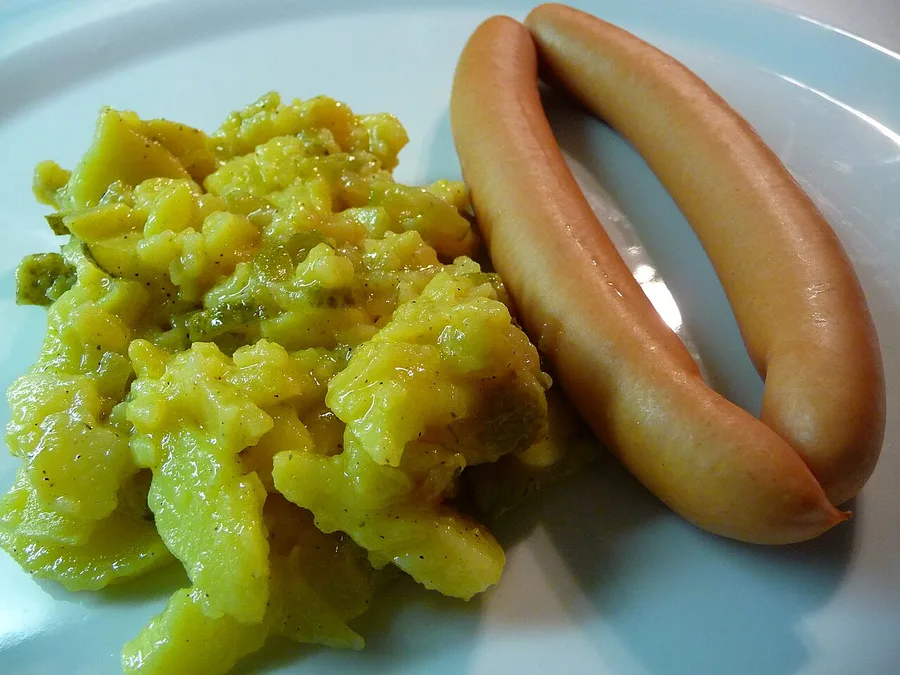
There are two good reasons for it. Christmas Eve used to be a fasting day, the last one before the feast, so the big meal belonged to Christmas Day. And it’s practical: with church, presents and family, nobody wants to stand in the kitchen all evening. Fish, especially carp, is the older Christmas Eve tradition and still on some tables.
Christmas Day and the second day of Christmas
Germany has two Christmas holidays: 25 December (Erster Weihnachtsfeiertag) and 26 December (Zweiter Weihnachtsfeiertag), both public holidays nationwide. These are the days for visiting family and the big festive meal: roast goose with dumplings and red cabbage, or carp. In Schleswig-Holstein, duck is more common.
In 2026, Christmas Eve falls on a Thursday, Christmas Day on Friday and the 26th on Saturday, so most shops are shut from Thursday afternoon until Monday 28 December. Our Germany in December guide has the details on what’s open.
The tree usually stays up for a while. In Bavaria, Baden-Württemberg and Saxony-Anhalt, 6 January (Epiphany) is another public holiday, and lots of families keep the tree at least until then. Some wait until Candlemas on 2 February, which was the official end of the Christmas season in the Catholic calendar until 1970.
Writing to the Christkind: Germany’s Christmas post offices
This is a sweet one if you have kids. Deutsche Post supports seven Christmas post offices where helpers answer children’s letters: three for the Christkind, two for the Weihnachtsmann and two for St Nicholas. Put a full return address on the letter, or no reply can come. Here are the Christkind and Weihnachtsmann addresses with this year’s deadlines:
| Who | Address | 2026 deadline |
|---|---|---|
| Christkind (North Rhine-Westphalia) | An das Christkind, 51777 Engelskirchen | Must arrive by 19 December (5 days before Christmas Eve) |
| Christkind (Bavaria) | An das Christkind, 97267 Himmelstadt | Must arrive by 17 December (schools and kindergartens by 15 December) |
| Christkind (Lower Saxony) | An das Christkind, 21709 Himmelpforten | Must arrive 10 days before Christmas Eve (14 December) |
| Weihnachtsmann (Brandenburg) | An den Weihnachtsmann, Weihnachtspostfiliale, 16798 Himmelpfort | Send by the third Sunday of Advent, 13 December |
| Weihnachtsmann (Lower Saxony) | An den Weihnachtsmann, 31137 Hildesheim (Himmelsthür) | Must arrive by the second Sunday of Advent, 6 December |
Engelskirchen is the busiest. In 2025 it got almost 130,000 letters from more than 50 countries. Kids from outside Germany can write too. Just add international postage and allow extra time for the mail.
Can you visit the Christkind?
Yes, at a couple of these. In Engelskirchen, near Cologne, the Christkind meets visitors on the Engels-Platz on 12 and 13 December 2026, from 13:00 to 18:00, during the town’s Christkind market. In Himmelstadt, near Würzburg, kids can hand in their letters at the Christmas post office (Kirchplatz 3) from 30 November to 18 December, Monday to Friday 9:00 to 11:00 and 15:00 to 17:00. If your family is more Team Weihnachtsmann, he’s at the Weihnachtsmannhaus in Himmelpfort, north of Berlin, Thursday to Sunday from 11:00 to 17:00 and on 21, 22 and 23 December.
Visiting Germany over Christmas Eve?
A few tips if you’ll be here on the 24th:
- Do your shopping early. Shops close by 14:00 on Christmas Eve, and most Christmas markets that are still open close around lunchtime. Most markets end on 22 or 23 December anyway, and our Christmas market calendar shows the dates.
- Book dinner ahead. Christmas Eve evening is quiet, and many restaurants close or only serve a set menu.
- Arriving after Christmas? Some markets reopen or keep going until New Year or even into January. Here’s our list of Christmas markets still open after Christmas.
For the markets themselves, start with our guide to German Christmas markets. If you’d like tips like these in your inbox, our newsletter is one email a month. Frohe Weihnachten (merry Christmas)! Pfiat di (take care), Brian
FAQ
Who brings the presents in Germany, Santa or the Christkind?
Both, depending on the region. In southern and western Germany, including Bavaria, the Christkind brings the presents. In the north and east, including Berlin, it’s the Weihnachtsmann, who looks like Santa. Either way the presents come on the evening of 24 December, not Christmas morning.
When do Germans open their Christmas presents?
On Christmas Eve, 24 December, usually in the early evening, often around 5 or 6 pm. This is called the Bescherung. Some families open presents before church and some after, but there’s no big present-opening on Christmas morning.
Is Christmas Eve a public holiday in Germany?
No. 24 December is a normal working day until the afternoon, and shops must close by 14:00 at the latest. The public holidays are 25 and 26 December. In 2026 those fall on a Friday and Saturday, so most shops are closed until Monday 28 December.
Can my kids write a letter to the Christkind from outside Germany?
Yes. Write to An das Christkind, 51777 Engelskirchen, Germany, add international postage and a full return address, and mail it early. For 2026, the letter needs to arrive by 19 December. Engelskirchen gets letters from more than 50 countries every year.
Sources
Checked on 27 November 2026:
- Atlas zur deutschen Alltagssprache: Christkind or Weihnachtsmann, regional map and background
- Germany Travel (German National Tourist Board): Heiligabend, Christbaum, Christkind und Weihnachtsmann
- Landratsamt Altötting: Christmas customs (locked room, bell, fasting day, Christmette)
- SWR: why presents are given on different days in different countries
- EKD: church service statistics 2024 (Christmas Eve and average Sunday)
- EKHN: celebrating Christmas (services, nativity plays, the bell)
- Stille Nacht Gesellschaft: the history of Silent Night (Oberndorf, 1818)
- Bild: INSA poll on Christmas Eve dinner, December 2025
- Bayern 1 (BR): Candlemas and why some trees stay up until February
- Studentenwerk Freiberg: Weihnachtsmann service on Christmas Eve
- Stadt Nürnberg: Nora Falk is Nuremberg’s Christkind for 2025/26
- Tourismus Nürnberg: 10 facts about the Nuremberg Christkind
- Nürnberger Christkindlesmarkt 2026: dates and opening with the prologue
- Deutsche Post: Christmas post offices for the Weihnachtsmann, Christkind and Nikolaus
- Deutsche Post: Christkind post office Engelskirchen (deadline, visiting days, letters in 2025)
- Deutsche Post: Christmas post office Himmelstadt (2026 deadline, drop-off times)
- Deutsche Post: Christmas post office Himmelpforten
- Deutsche Post: Christmas post office Himmelpfort (2026 deadline, Weihnachtsmann visiting hours)
- Deutsche Post: Christmas post office Himmelsthür
- Federal Shop Closing Act (LadSchlG), § 3: shops close at 14:00 on 24 December
- Bavarian State Ministry of the Interior: public holidays in Bavaria
- Federal Foreign Office: German public holidays 2026 (circular note)
Photos: top photo, a German Christmas tree by Gerbil, CC BY-SA 3.0, via Wikimedia Commons (cropped and resized); potato salad with sausages by 3268zauber, CC BY-SA 3.0, via Wikimedia Commons (resized).