
Updated 10 November 2026. All 2026 event dates and times below were checked on the organizers’ and tourism boards’ own websites on 10 November 2026.
Short answer: St Nicholas Day (Nikolaustag) in Germany is 6 December. On the evening of 5 December, kids put a cleaned boot outside the door, and by morning Nikolaus has filled it with nuts, tangerines and chocolate. In Bavaria and Austria, 5 December is also Krampusnacht, when his horned helper Krampus comes out. In 2026 that’s Saturday 5 and Sunday 6 December.
Servus (hi)! 👋 We live in a small German village near the Austrian border, south of Rosenheim, and early December is one of my favorite times of year around here. St Nicholas Day is a big deal in this part of the world, and it surprises a lot of Americans, because most of us grew up with Santa and stockings and nothing much on 6 December.
Here’s what happens on these two days, who Krampus is, and where to see Nikolaus and Krampus in person in 2026.
When is St Nicholas Day in Germany in 2026?
| Day | 2026 date | What it’s called | What happens |
|---|---|---|---|
| Evening before | Saturday 5 December | Nikolausabend, and Krampusnacht in Bavaria and Austria | Boots go outside the door. Nikolaus visits some homes and markets. Krampus runs in many Alpine towns. |
| The day itself | Sunday 6 December | Nikolaustag (St Nicholas Day) | Kids check their boots in the morning. More Nikolaus visits at Christmas markets. |
6 December is not a public holiday in Germany, so in a normal year schools and shops are open. In 2026 it lands on a Sunday, which means shops are closed anyway (German shops close on Sundays). It’s also the second Sunday of Advent this year.
Christmas markets do open on Sundays, though. The big Munich Christkindlmarkt on Marienplatz, for example, runs 20 November to 24 December 2026 and is open Sundays from 10:00 to 20:00. So a St Nicholas weekend fits in nicely with a market trip. Our 2026 Christmas market calendar has dates for markets all over Germany.
What happens on St Nicholas Day?
Boots on the doorstep
This is the part kids love. On the evening of 5 December, they clean a boot or shoe (that’s half the point) and put it outside the front door. Overnight, Nikolaus fills it. The classic things are tangerines, nuts, a chocolate Nikolaus and maybe a small gift. Germany’s national tourism board mentions that plenty of grown-ups put their shoes out too, which I think is great.
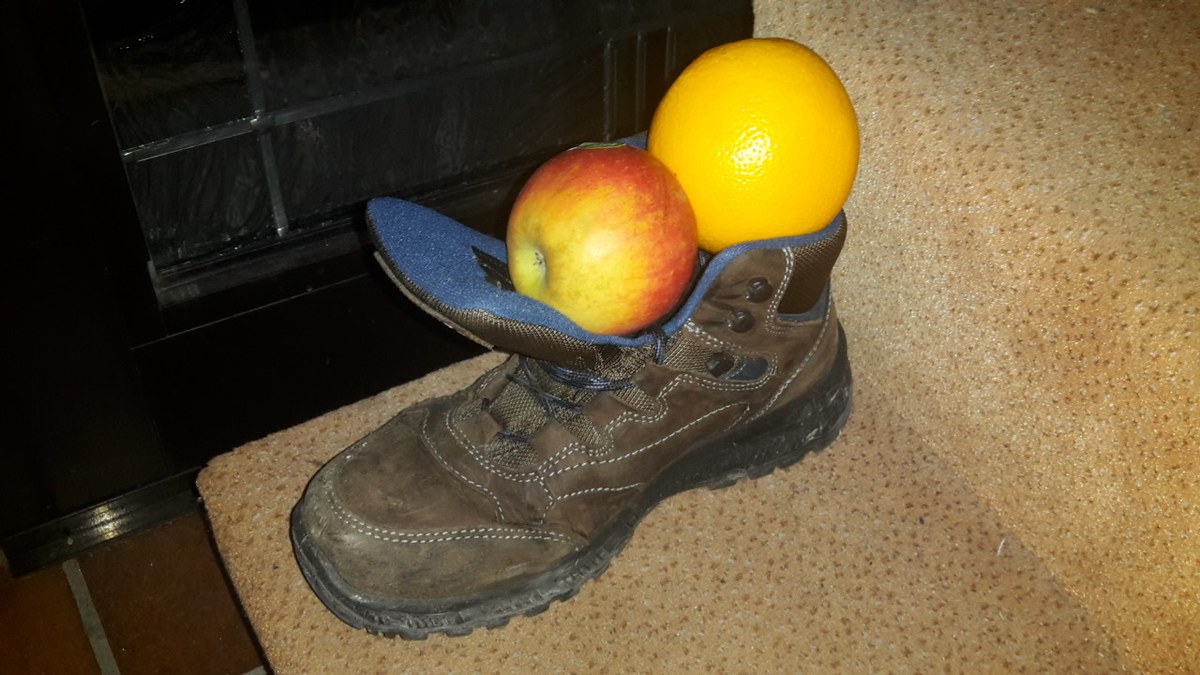
There’s a nice reason it’s a boot. St Nicholas is the patron saint of sailors, and kids used to make little paper boats for him to fill. Over time, shoes and boots took the place of the boats.
If a child was naughty, the old tradition says they might find a Rute (a bundle of twigs) instead. These days that’s mostly a joke between parents and kids.
Nikolaus in person
In a lot of families, kindergartens and clubs, someone dressed as Nikolaus still drops by on the 5th or 6th. He wears a bishop’s robe and miter, carries a staff and a golden book, and reads out what the kids did well this year (and a few things to work on). Kids often say a short poem or sing a song, and then they get a treat from his sack.
He’s not Santa. Here Nikolaus looks like a bishop, and the real Christmas presents come later, on Christmas Eve.
Who was St Nicholas?
He was a real bishop, Nikolaus of Myra, in what’s now Turkey, in the 4th century. Tradition says he died on 6 December (probably around the year 343), which is why the day is 6 December. He’s known for helping the poor in secret, and he’s the patron saint of children and sailors.
Krampus, Knecht Ruprecht and the other helpers
Nikolaus never travels alone. He has a darker sidekick whose job is to deal with the naughty kids, and the name changes depending on where you are in Germany.
In the north and middle of Germany, it’s usually Knecht Ruprecht, a gruff figure in a dark robe with a sack and switches. In the Alps (southern Bavaria, Austria and South Tyrol) it’s Krampus: horns, fur, a carved wooden mask, cowbells and chains. Other regions have their own names too, like Pelzmärtl or Hans Muff.
Today Krampus is mostly a big, loud show put on by local clubs. The organizers of the Munich Krampus run say a costume costs about €1,800 to €2,500, and a single mask can weigh up to 10 kilograms. The evening of 5 December is called Krampusnacht (Krampus night) around here.
You’ll also hear about Perchten. They look similar to an outsider, but they come from an older Alpine tradition about chasing away the spirits of winter, and their runs often happen later, around the nights between Christmas and Epiphany. My guide to Krampus runs in Bavaria and Tyrol goes into the difference and lists more 2026 dates.
Where to see Nikolaus and Krampus in 2026
Most of the bigger public events in our corner of the world fall on 5 and 6 December, plus a few on the weekends either side. These are the ones with confirmed 2026 dates.
| Where | Date and time (2026) | What it is |
|---|---|---|
| Rosenheim, Max-Josefs-Platz | Sat 5 Dec, 16:00 | Nikolaus arrives by carriage at the Christkindlmarkt with Krampus and angels |
| Berchtesgaden | Sat 5 Dec, 14:00 start, Schlossplatz around 15:15 | Nikolaus parade with Buttnmandl and Kramperl (the local Krampus figures) |
| Salzburg (Austria), Domplatz | Sat 5 Dec, around 19:00 | Krampus run at the Christmas market |
| Kundl (Tyrol) | Sat 5 Dec | Nikolaus arrives, then Perchten and Krampus groups go through the village |
| Salzburg (Austria) | Sun 6 Dec, 15:30 | Nikolo and Kinderkrampus (kids’ Krampus) walk at the market |
| Bad Tölz, Marktstraße | Sun 6 Dec, 17:00 | Nikolaus visits the Christmas market by horse sleigh |
| Rattenberg (Tyrol) | Sun 6 Dec | Traditional Perchten run with drums, masks and fire |
| Bad Tölz, Marktstraße | Sat 12 Dec, from 17:45 | Big Krampus run |
| Munich old town | Sun 13 Dec, 15:00–17:00 | The big city Krampus run, about 25 groups |
Rosenheim: Nikolaus at the Christkindlmarkt
Rosenheim’s Christmas market runs 27 November to 24 December 2026. On Saturday 5 December at 16:00, Nikolaus pulls up on Max-Josefs-Platz in a carriage, with Krampus and his angels. The organizers say any child who recites a poem or sings him a Christmas song gets a small surprise.
It’s a gentle, family-style event, not a wild Krampus run. Rosenheim and the other markets along the border are in my guide to Christmas markets on the German-Austrian border.
Berchtesgaden: the Nikolaus parade on 5 December
Berchtesgaden has its own version of Krampus called Buttnmandl: men wrapped head to toe in straw, with fur masks and huge cowbells. They go house to house with Nikolaus on the evenings around St Nicholas Day.
Those house visits are a private family tradition, not a show, so please don’t follow them around. The public one is the parade put on by the mountain troops (Gebirgsjäger) from their barracks in Strub. It starts at 14:00 on 5 December, there’s Glühwein and Kinderpunsch (the alcohol-free punch) at the barracks from 13:30, and it reaches Berchtesgaden’s Schlossplatz around 15:15. Nikolaus and his angels bring small gifts for the kids.
Bad Tölz: Nikolaus on a horse sleigh
Bad Tölz’s Christmas market on the painted Marktstraße runs 27 November to 24 December 2026, daily 11:00 to 19:00. On Sunday 6 December, the Christkind post office opens on the stage at 16:00, and at 17:00 Nikolaus arrives by horse sleigh near the town museum to visit the kids.
The town’s big Krampus run is the following Saturday, 12 December, from 17:45.
Salzburg and Tyrol, just over the border
Salzburg’s Krampus run on the cathedral square is on Saturday 5 December, expected around 19:00. On Sunday 6 December there’s a gentler Nikolo and Kinderkrampus walk at 15:30, and at 16:00 Nikolaus welcomes the Christkind on the cathedral square. More on Salzburg in my Christmas markets near Salzburg guide.
In Tyrol, the tourism board lists Kundl (5 December) and Rattenberg (6 December) in the Lower Inn Valley, plus Seefeld (4 December) and Innsbruck (3 and 4 December). Some are free and some charge entry, so check the event page first.
Munich: later in the month
Munich’s big Krampus run isn’t on St Nicholas weekend. It’s on Sunday 13 December 2026, from 15:00 to 17:00, through the old town during the Christkindlmarkt. About 25 groups take part. For the rest of December in the city, see my Munich Christmas markets guide.
How I’d plan a St Nicholas weekend
If I had visitors staying with us for 5 and 6 December 2026, this is roughly how I’d do it.
Saturday afternoon I’d go to Rosenheim for the Nikolaus arrival at 16:00, have a Glühwein, and walk the market. Rosenheim is on the train line between Munich and Salzburg, so if you want the big Krampus run that evening, you can carry on to Salzburg for 19:00. Just check the last train back before you settle in.
Sunday I’d keep it slow. Put the boots out Saturday night, have a late breakfast, then head to Bad Tölz for the 17:00 Nikolaus visit, or to Rattenberg if you want the Perchten run.
If you’re traveling around Bavaria by regional train that weekend, the Deutschlandticket or Bayern-Ticket is usually the cheapest way to do it.
Is Krampus too scary for kids?
It depends on the kid. A Krampus run is loud (cowbells, chains, drums), it’s usually dark, and the Krampusse sometimes swat at people’s legs with switches if you stand right at the front. Little ones can find that a lot. A Nikolaus arrival like Rosenheim’s or the Salzburg Kinderkrampus walk is a much easier first taste.
Our boys are teenagers now, and teens usually just think the costumes are amazing. Whatever the age, stand where you can step back easily, and don’t grab the masks or costumes. For more on Christmas markets with kids (strollers, Kinderpunsch, rides), see Christmas markets with kids in Germany.
What to put in a Nikolaus boot
If you’re in Germany with kids on 5 December, it’s an easy tradition to join in. Supermarkets and bakeries sell everything you need in the weeks before.
The classic mix is a tangerine or orange, walnuts or peanuts in the shell, a chocolate Nikolaus, and maybe some Lebkuchen (soft gingerbread). Add a small gift if you like. Then put the boot by the door of your room, and you’re set.
Our Christmas market food guide covers the rest of what you’ll see at the stalls that weekend.
For the bigger picture, start with our German Christmas markets guide or the Christmas markets map. And if you’d like more tips like this, our newsletter is one email a month. 🎄
Hope you have a great trip!
Pfiat di (take care), Brian
FAQ
When is St Nicholas Day in Germany in 2026?
St Nicholas Day (Nikolaustag) is always 6 December. In 2026 that’s a Sunday. Kids put their boots out on the evening before, Saturday 5 December, which in Bavaria and Austria is also called Krampusnacht.
Is St Nicholas Day a public holiday in Germany?
No. 6 December is not a public holiday, so in a normal year shops and schools are open. In 2026 it falls on a Sunday, so shops are closed anyway, but Christmas markets are open.
What do German kids get on St Nicholas Day?
Children clean a boot and put it outside the door on the evening of 5 December. By morning it’s filled with things like tangerines, nuts, a chocolate Nikolaus and sometimes a small gift.
What is the difference between Krampus and Knecht Ruprecht?
Both are St Nicholas’s helpers who deal with naughty children. Knecht Ruprecht is the usual figure in northern and central Germany. Krampus, with horns, fur, a carved mask and cowbells, belongs to the Alps: southern Bavaria, Austria and South Tyrol.
Where can I see a Krampus run around St Nicholas Day 2026?
Salzburg has a Krampus run on Saturday 5 December around 19:00, and Kundl in Tyrol also has one on 5 December. Rosenheim’s Nikolaus arrives with Krampus on 5 December at 16:00. Bad Tölz’s Krampus run is 12 December and Munich’s is 13 December, 15:00 to 17:00.
Sources
Checked on 10 November 2026:
- Rosenheim Christkindlmarkt 2026 (Wirtschaftlicher Verband)
- Berchtesgaden tourism: Buttnmandl und Kramperl
- Bischofswiesen: Buttnmandl, Kramperl und Nikolaus
- Bad Tölz: Tölzer Christkindlmarkt 2026
- Salzburger Christkindlmarkt: key dates 2026
- Tirol Werbung: Krampus and Perchten runs in Tyrol 2026
- Münchner Christkindlmarkt: Krampuslauf 2026
- Münchner Christkindlmarkt 2026: dates and opening hours
- Germany Travel: Advent and Saint Nicholas
- Planet Wissen (WDR): Nikolaustag traditions
- WDR: Nikolaus, Stiefel und der Weihnachtsmann
- Jesus.de: Warum wir Schuhe rausstellen
Top photo: Alessandro Caproni, CC BY 2.0, via Wikimedia Commons.